
Subcontracting starts with a prime contractor named on a contract award. The same work is searched as subcontract work, subcontractor opportunities or, before an award, teaming. Three questions follow a prime's name: does that company have work to share, does the work fit a particular business, and who makes the decision? An award record answers none of them. It lists the winner, the agency, the value and the date, so a message built only on that record has nothing specific to say about the project.
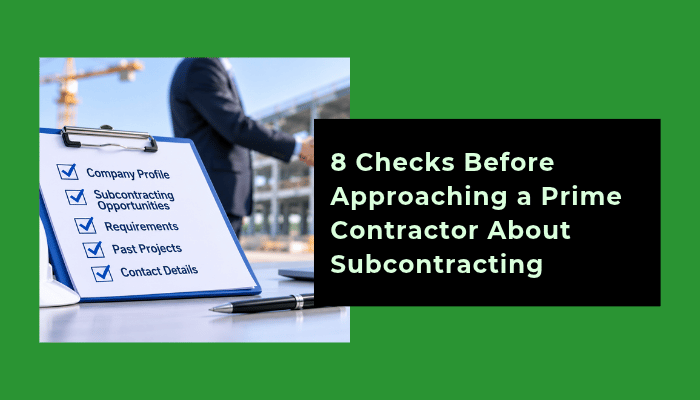
Several rules and systems changed in 2026, including where subcontracting reports are filed, how award records are searched, and how set-aside contracts are policed. The checklist below covers eight checks, from verifying the award to deciding whether to pursue it.
Prime Contractor Research Checklist for Federal Subcontracting
1. How Can a Prime Contractor Be Verified Against the Actual Contract Award?
An award record begins with a name. First we determine if the name from the award record aligns with the contract we are researching. Companies appear repeatedly in their subsidiaries, joint ventures and affiliated companies; therefore, the agency, contract title or award number as well as the award date, will have to be identical prior to drafting of a response. Award searches were discontinued via FPDS.gov’s “ezSearch” Public Search Tool on February 24, 2026, and thus all searches for awards are currently conducted through SAM.gov.
Awards are modified over time, and the current record shows whether the version being read still describes the work. Confirmed contract award records that list the winning vendor, agency, value and classification codes make this check faster when many primes are being compared.
- ☐ Confirm the company named in the contract award record.
- ☐ Match the contract to the relevant government agency and project.
- ☐ Check the award date, current status and available contract details.
Data to review: Award records, prime contractor profiles, and contract status.
2. How Can a Business Tell Whether a Government Project Is Still Worth Pursuing?
A correct prime on a finished contract goes nowhere. The period of performance, option years and modifications show where the project sits in its life, and that decides whether outside help is still being bought. Funding timing adds to this in 2026: a continuing resolution signed on September 2 keeps agencies funded at fiscal year 2026 levels through December 11.
Where a project is still at the tender stage, tender-to-award tracking across US agencies shows when a notice becomes a confirmed award, where that information is publicly available. A subcontracting record carries a status such as Actively Seeking' or 'Open Requirement' when the source indicates one, and a missing deadline calls for a second look at the contract dates.
- ☐ Check the contract period and any available updates or modifications.
- ☐ Determine whether the project is active, upcoming or nearing completion.
- ☐ Look for evidence that the work is still relevant to the business's services.
Data to review: Contract dates, opportunity status and award updates.
3. How Does a Business Find the Work on a Contract That Matches Its Capabilities?
The comparison starts with the scope, not the contract title. A contract titled as an infrastructure upgrade can hold separate tasks for cabling, cybersecurity compliance and staffing, and each task has its own qualifications. The part a business can deliver is usually one of those tasks.
Experience, certifications and capacity then go against the requirement. NAICS codes shorten this step, because the code attached to a requirement shows which industry the work belongs to and whether it falls in a primary or secondary line of the business. Subcontractor opportunities organized by industry and NAICS code show which tasks fit before any outreach begins, on records where a code is available.
- ☐ Review the project scope, requirements and deliverables.
- ☐ Identify services or specialist tasks the business can provide.
- ☐ Compare the project requirements with experience, certifications and capacity.
Decision to make: What specific part of the project could the business deliver?
Also Read: What Are Awardee, Incumbent, Prime Contractor and Subcontractor?4. What Does a Prime Contractor's Award History Show About Subcontracting?
One contract shows one project. The other awards held by the same prime show where it keeps buying. Repeat agencies, recurring industries and similar project types point to work that returns, which makes a prime with several contracts in the same field a more useful contact than one with a single unrelated award.
Reported subawards add a second view. Prime contractors report first-tier subcontract awards that meet the FFATA threshold, and that data appears on USAspending.gov beside the prime award, giving a high-level picture of the work a prime has already placed with outside businesses. Prime contractor award history tagged by agency, NAICS code and state shows the same pattern across many primes without opening each record.
- ☐ Review other government awards held by the company.
- ☐ Identify recurring agencies, industries or types of projects.
- ☐ Look for patterns that align with the business's services.
Data to review: Award history, industry information and agency activity.
5. How Can a Business Check Whether Subcontracting Is a Viable Route on a Contract?
To begin your subcontracting plan. The Federal Acquisition Regulation (FAR) as amended by FAC 2026-01 on March 13, 2026, requires a large prime contractor to submit a subcontracting plan if their contract is expected to be over $900,000; however, construction contracts require a subcontracting plan if they are expected to be over $2 million. Small contractors do not submit a subcontracting plan, and set-asides for 8(a) programmes do not include the subcontracting plan requirement.
The plan will list the required percentages of small business, veteran-owned, service-disabled veteran-owned, HUBZone, small disadvantaged, and woman-owned small business subcontracting. The prime contractor will report the results of these plans via SAM.gov (which replaced eSRS in February). The "goal" listed in a subcontracting plan does not ensure an individual subcontract exists but rather is an estimate of the prime contractor's total spend. Where a source publishes a set-aside preference such as 8(a), HUBZone, WOSB, or SDVOSB, subcontracting records with business requirements and preferences carry it in the requirement fields.
How Do Limitations on Subcontracting Affect Set-Aside Contracts?
On a set-aside contract, the prime may pay only a capped share of the contract to firms outside its own small business program status. A similarly situated entity is a subcontractor that shares the program status the prime needed for the award, such as service-disabled veteran-owned status, and meets the size standard. Payments to that kind of firm count as the prime's own performance and stay outside the cap.
Source: SBA Office of Inspector General, Report 26-19, September 30, 2026.
Enforcement tightened in 2026. The Justice Department secured a $21.3 million settlement in June over the use of small businesses as pass-through entities on more than 90 set-aside contracts, SBA suspended over 1,000 contractors from the 8(a) program in January for not answering its audit request, and SBA told its inspector general that a draft revision of 13 CFR 125.6 with new subcontracting thresholds will be ready by April 1, 2027. Before approaching a set-aside prime, the useful questions are what share of the work the prime must perform and which tasks are left to place.
Does Defense Work Add a Cybersecurity Check?
Yes. The primes determine the CMMC level of all their subcontractors based on the information they have access to; and as such there is no requirement for "flow down" to any subcontractors who will be receiving neither Federal Contract Information (FCI) nor Controlled Unclassified Information (CUI).
- ☐ Review the terms of any contracts related to this project and any potential subcontracting requirements.
- ☐ Determine if small business participation requirements apply.
- ☐ Determine if there are any restrictions, eligibility criteria or other requirements relative to the proposed work.
- ☐ Verify If There Are Cybersecurity Flow-Down Requirements in This Contract.
Important: A subcontracting plan or small-business target does not guarantee that a prime contractor has an open subcontracting opportunity.
6. Who Should Be Contacted at a Prime Contractor About Subcontracting?
FAR 19.704 requires a subcontracting plan to name the person who administers the prime's subcontracting program. For large defense primes with comprehensive plans, the Department of War's Prime Contractor Directory, updated May 12, 2026, lists a Small Business Liaison Officer. For other primes, SBA's directory of primes with subcontracting plans lists vendor, agency, NAICS code and contract value, and SBA advises using it to find the prime's website and follow the supplier instructions published there. A local APEX Accelerator, the program formerly called PTAC, helps businesses pursue work with government prime contractors, and most of its assistance is free.
SBA's SUBNet lists opportunities that primes have posted, and SBA's page currently states that posting new opportunities is unavailable, so the listing may be thin. A job title from a contact record needs a check against the prime's website or a recent project announcement before a message goes out. Prime contractor business development, supplier and procurement contacts tied to a specific prime and contract shorten that step where the details are publicly available.
- ☐ Identify relevant procurement, subcontracting, supplier-diversity or project contacts.
- ☐ Verify the person's role and connection to the project where possible.
- ☐ Check for supplier registration portals or published subcontractor onboarding processes.
Data to review: Business contact details, job titles and company information.
Also Read: Government Contractor vs Subcontractor: Who Wins Where?7. What Should a Subcontracting Outreach Message Include?
A project-specific response follows an order. The first sentence names the contract/project and agency. The second sentence states what work the company can support (with the applicable NAICS code). Next are short blocks on past performance, qualifications, and delivery capacity; then the closing question is whether the prime contractor is considering subcontractor(s) to perform that work.
Some primes ask suppliers for a capabilities statement, and a subcontracting record marked Capabilities Statement Requested shows that the prime has asked for that document.
- ☐ Reference the relevant contract or project.
- ☐ Explain which requirement the business can support.
- ☐ Include relevant past performance, qualifications and delivery capacity.
- ☐ Ask whether the prime is considering subcontractors for the work.
8. How Does a Business Decide Whether to Pursue, Research Further or Move On?
Each prime ends the research in one of three states. A short log with the prime's name, the contract ID, the decision and the reason shows which agencies and industries keep producing fits.
- ☐ Pursue: The project fits capabilities, and a relevant contact or process is available.
- ☐ Research further: Key details, project status or subcontracting requirements remain unclear.
- ☐ Move on: The scope, timing or requirements do not fit the business.
How Can Subcontracting Opportunities Data Support Prime Contractor Research?
Every check above matches a field in a subcontracting record. A subcontracting opportunities database connects the prime contractor to the underlying contract or project, the contracting organisation, the value and scope, the industry classification, the subcontracting requirement and the opportunity status. Sources are monitored every 24 hours across 25+ industries and all 50 US states, and each record's currency follows the date its source published it. Available fields depend on what each source publishes.
Prime Contact fields list business development, subcontracting, supplier, procurement or partnership contacts where publicly available. Datasets can be limited to chosen US states, industries, NAICS codes, clients or prime contractors, and a sample matched to a target industry or NAICS code can be requested before any purchase.
Where Does Effective Subcontracting Outreach Start?
Effective subcontracting outreach starts with contract research. The eight checks answer the three opening questions: whether the prime has work to share, whether that work fits the business, and who makes the decision. The purpose of the research is to find projects where the business's capabilities and the available information give a credible reason to start a conversation.
Pick one prime from a recent award in the target industry and run all eight checks before drafting a message.
Frequently Asked Questions
What is subcontracting in government contracting?
A prime contractor responsible for delivering a government contract assigns part of the work, products, services or staffing to another business under a subcontract. Work the prime places directly is first-tier subcontracting, and the same subcontractor can place further work with lower-tier firms.
When is the best time to approach a prime contractor about subcontracting?
Both before and after award are used. Companies normally form a team arrangement before an offer is submitted, and FAR 9.602 allows them to form one later, including after award. A contracting officer may require a subcontracting plan with initial offers or at any point before award, so small business participation can be settled during the proposal stage. After award, a record marked 'Actively Seeking' or carrying a response deadline shows an open need.
What is the difference between a teaming arrangement, a joint venture and a subcontract?
FAR 9.601 recognises two kinds of contractor team arrangements. In the first, two or more companies form a partnership or joint venture to act as a potential prime contractor. In the second, a potential prime agrees that other companies will act as its subcontractors under a specified contract. The arrangement must be identified in the offer under FAR 9.603, and the subcontract is the agreement the subcontractor performs under once the prime holds the award.
Does a subcontractor need a SAM.gov registration or UEI?
A unique entity ID, issued free through SAM.gov, is what primes commonly ask for, because first-tier subaward reports carry the subcontractor's UEI. SAM.gov issues a UEI without a full entity registration to businesses that will not bid as primes. Full registration is needed to receive a contract directly from the government, and a prime can still ask its suppliers for it, so the prime's supplier terms decide. Lockheed Martin, for one, told its suppliers in 2022 that subcontractors under government prime contracts need a UEI.
What payment rules protect subcontractors?
Payment terms are set in the subcontract. FAR 52.232-40 adds one federal rule for small businesses: when the government pays a prime on an accelerated basis, the prime pays its small business subcontractors within 15 days, to the maximum extent practicable, after a proper invoice and without added fees. The clause creates no new Prompt Payment Act rights and does not require accelerated payment to large business subcontractors.
Which FAR clauses flow down into a subcontract?
The prime contract and the subcontract's type and value decide this. FAR 52.244-6 lists the clauses a prime inserts in subcontracts for commercial products or services, including 52.203-13 on business ethics for larger, longer subcontracts and 52.219-8 where the subcontract offers further subcontracting opportunities. FAR 52.232-40 flows down to subcontracts with small businesses. The clause list in the subcontract itself is the document to read before signing.
What is an ostensible subcontractor?
Under 13 CFR 121.103, an ostensible subcontractor is a subcontractor that is not a similarly situated entity and performs the primary and vital requirements of a contract, or one the prime is unusually reliant on. SBA's inspector general found signs of this relationship in three of the eight oversight reports it reviewed in 2026.
Does the CMMC Phase II suspension remove cybersecurity requirements for defense subcontractors?
No. The Department of War suspended Phase II on July 13, 2026, and no new date had been announced by mid-October. Phase I self-assessment requirements, DFARS 252.204-7012 and NIST SP 800-171 Rev 2 remain in force. Subcontractors that handle controlled unclassified information submit self-assessment results and affirmations into SPRS, and the prime's flow-down clause shows which level applies to a given supplier.